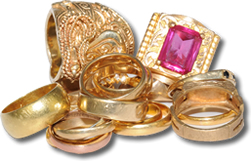
14ct gold rings
Having all the necessary information is the key to making a good decision. If you’re looking to sell some of your 14 carat gold items and aren’t aware of the market value of it, then you could be at risk of being taken advantage of. In some cases, unaware members of the public have been offered as little as 20% of the real value of their gold. Read on, and find out how much 14ct gold is per gram.
In this detailed article, I’m going to explain how you can calculate the value of your 14ct gold and how to compare quotes from different companies. This information is vital for you to get the best deal possible. I can tell you now that by not doing this, you could possibly end up being paid between 50% – 60% less for your items.
What is 14ct Gold?
You might already know that the carat (ct) is the traditional unit used to denote the purity of gold alloys. The higher the number, the more ‘pure’ the gold, i.e. the alloy has more gold content and fewer other metals. In the United States, it’s spelt ‘karat’ (k / kt).
The formula used by the gold industry measures carat purity as 24 x the purity by mass. So 14ct gold is 14 parts gold, 10 parts other metal. In percentage terms, that’s 58.33% fine gold. You’ll see on the hallmark for 14ct gold in the UK is generally expressed in millesimal fineness these days. A convention exists in continental Europe to round up the figure to 58.5%, hence the hallmark figure of ‘585’.
The colours 14 carat gold is available in are yellow, rose and white. An alloy of copper will give a more red colour (rose gold), whilst metals such as silver, zinc and palladium will provide a more white colour. An even mix of copper and silver will produce a yellow colour.
How Much Is 14ct Gold Today?
Now you know what your 14ct gold is composed of. The burning question following that is, what’s it worth?
Right now, Gold-Traders is paying £ for 14ct gold. This is the live price, which moves with the market rate, so our quotes are always up-to-date.
If you’d like a comprehensive view of all our scrap gold rates, then have a look at our Scrap Gold Prices page. We encourage you to shop around and find other quotes to compare against. We’re confident that we have some of the best rates in the market for 14ct gold, so if you do come across another firm offering a better rate, then let us know!
‘Free’ Envelope Rip-Off
Now that you have a fair and honest offer for your 14ct gold, the next question is: how are you going to get your precious metal to the buyer? There’s a few options.
- Fill in our claim form and post your gold to us. We recommend Royal Mail Special Delivery as it’s insured and tracked. Remember to retain your proof of postage slip.
- Visit us at our trade counter in person and sell your gold face-to-face. We welcome walk-ins, with our operating hours between 10:00am and 4:30pm, Monday to Friday. Our address is 143, High Street (Station Road entrance), Royal Wootton Bassett, SN4 7AB, and our telephone number is 01793 230 331.
Contrast this with certain ‘cash-for-gold’ firms, who send you a ‘free’ postage bag or envelope. This is just marketing bluster. Scratch the surface a bit on these companies and you’ll find they don’t advertise their rates (most likely because they’re not as good as ours), their pre-paid mailers don’t provide any additional protection for your items and despite their claims of paying ‘top prices’, the worst players pay over 60% less than us!
How Do You Identify 14-carat Gold?
From the customer’s end, the easiest way to identify 14 carat gold is to check the hallmark. It’ll be labelled as ‘585’, with some older items carrying the label ’14ct’ or just ’14’.
We can accurately test gold in our premises using an XRF (x-ray fluorescence spectroscopy) machine, which leaves no mark on the items.
14ct gold is a popular purity in countries such as Greece and Italy. Customers should be aware there is no official guarantee or hallmarking standard in these countries. In our experience, items marked as 14 carat (14k) from Greece are often slightly less pure due to ‘under carating’ – around the 55% purity mark.
Hardness of 14 Carat Gold
14 carat gold is considered a compromise between 9ct gold, which some view as affordable but undurable, and 18ct gold, which is durable but more expensive. A common myth is that the higher the carat, the softer the gold is – this isn’t true!
There’s actually a measurement for metal hardness called the Vickers scale, and 14ct cast gold is in the 100 – 165 HV scale, depending on the other metals used. This is harder than both 9ct gold and 18ct gold in cast form, but note that the maximum annealed hardness of 14ct gold is lower than 18ct gold.
14ct Gold Jewellery
14ct gold is sometimes used for men’s rings, as the higher carats such as 22ct and 24ct, while more valuable, are considered too soft and less able to withstand prolonged wear. It’s a popular purity in countries such as Greece and Italy. Customers should be aware that there is no official guarantee or hallmarking standard in these countries. In our experience, items marked as 14ct from Greece are often of slightly lesser purity – around the 55% purity mark.
Selling with Gold-Traders UK
If you weigh your scrap 14ct gold you can then use our online calculator to get an accurate quote. Look at our page about how to weigh your scrap gold, but don’t worry if your own scales aren’t that accurate – we will use our calibrated and Trading Standards-approved scales to determine the exact weight and make sure you get an exceptional offer for it.
Further reading