Charles III will be officially crowned King on the 6th May, 2023, using the Saint Edward’s Crown. Encrusted with 444 precious and semi-precious stones and weighing 2.23kg (4.9lb), many have speculated as to what the monetary value of the crown is. A few publications have attempted to break down the components of the historical relic, which gives a rough figure of £45.4 million, but we’ll do a bit more digging to figure out what it’s really worth.
What is St Edward’s Crown?
Saint Edward’s Crown is widely viewed as the centrepiece of the Crown Jewels and has traditionally been used in coronation ceremonies to crown British Kings and Queens. It’s the symbol most associated with the British Monarchy which can be found in the insignia of many organisations in the United Kingdom and the Commonwealth. In everyday life, you’ll find it on Elizabeth II’s royal cypher, post boxes, police badges and military insignia to name but a few.
The crown is usually kept safe alongside the other items of royal regalia in the Tower of London, where the public can view it in the confines of an official museum. It measures 12 inches tall and has a circumference of 26 inches, but some of the specifications could vary slightly as it’s reshaped for new monarchs.
In the most recent coronation, the late Queen Elizabeth II wore St Edward’s Crown, but only for a brief moment. She switched to the lighter Imperial State Crown for the rest of the ceremony. Wearing the heavy St Edward’s Crown was a challenge, given its weight and the fact it added a foot to the Queen’s height. The cumbersome crown made simple tasks such as reading off a script quite difficult, as recalled in this quote given by Elizabeth II to Smithsonian Magazine in 2018:
‘You can’t look down to read the speech, you have to take the speech up. Because if you did, your neck would break and it [the crown] would fall off.’
It’s likely Charles III will keep this in mind, and switch to the Imperial State Crown for the remainder of the ceremony to spare his neck!
How Much Is St Edward’s Crown Worth?
To provide an objective figure of value for St Edward’s Crown is possible, but it’s almost certain that its subjective value is many, many times greater. After all, an item is only worth what somebody is willing to pay for it. Reader’s Digest has speculated that it’s worth £45.4 million, but we’ll break down the crown by splitting out the materials used to construct it.
Take the gold content. When the metal is isolated, it leaves 2,028.4 grams of 22 carat gold. This is equivalent to 59.7780 troy ounces of pure gold. With a spot price of £1,624 per troy ounce as of 4/5/23, this would give a spot value of £97,079.47. Now, if you happen to find yourself in possession of this Crown Jewel, and you wanted to sell it for its scrap gold content, then we’d pay £89,553.86. That’s over 90% of the spot value, which is one of the best rates for scrap gold in the country. There’s no need to worry if it’s hallmarked or not: we offer the same rate for both, although it would greatly amuse us to find out if it was.
The gemstones and diamonds in St Edwars’s Crown are the main driving force behind the royal regalia’s value, but their exact weight is not known. In total, it features 444 precious and semi-precious stones, including 345 rose-cut aquamarines, 37 white topazes, 27 tourmalines, 12 rubies, 7 amethysts, 6 sapphires, 2 jargoons, 1 garnet, 1 spinel and 1 carbuncle. Combined, it’s likely these stones would fetch a figure of approximately £3.6 million going off guides published by the International Gem Society. Although there no specific diamond or gemstone which stands out in its own right on the crown, the fact that it was placed on it would likely inflate the value of the particular stone immensely. So, this would give a figure of at least £3,689,553.86.
There’s one last, rather unusual way of valuing St Edward’s Crown. Sharp observers will wonder if the crown is insured. One would think this would be a sensible thing to do, but amazingly, it isn’t. According to the London Evening Standard, the reason why no value is given to any item in the Crown Jewels is because they’ve never been considered for sale. But, if you want something insured, then you need to get the item appraised and valued. It’s not clear if the Royal Collections have ever done this. If they have, it might be that the insurers have looked at the St Edward’s Crown and deemed it priceless! A shame, as the Royal Collections seem to have missed out on building a no-claims bonus.
Brief History of St Edward’s Crown
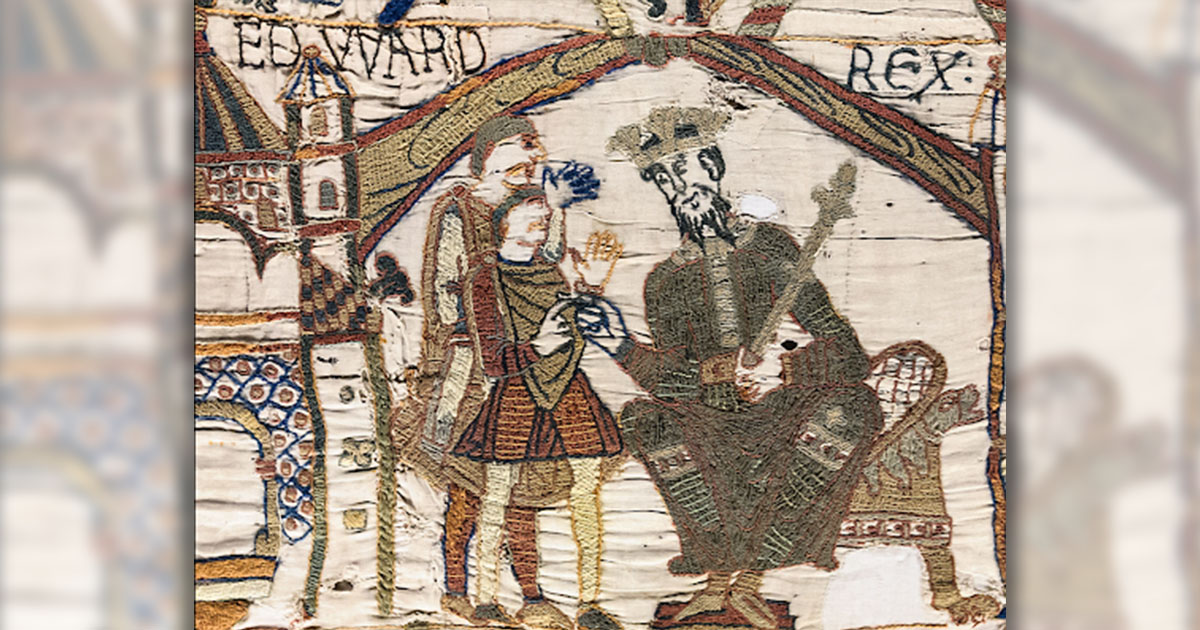
The crown can trace its origins to Edward the Confessor, the patron saint and Anglo-Saxon King which it was named after, with its first documented use in the coronation of King Henry III in 1220. From then, it was used in the coronation of Kings and Queens until the Interregnum. Unfortunately St Edward’s Crown didn’t survive the upheaval of that period, with conventional wisdom pointing toward the Commonwealth Government melting down the crown and striking coins out of it. This has never been confirmed.
A modern replica was made for the coronation of Charles II in 1661, reviving the centuries-old tradition. It didn’t last long though, as there was a 226-year gap between its use for King James II in 1685 and for George V in 1911. Edward VII was the inspiration behind its reintroduction, however he was recovering from an operation at the time of his coronation and opted for the lighter Imperial State Crown instead. Since then, the sight of Saint Edward’s Crown being placed on the monarch’s head by the Archbishop of Canterbury has been an integral part of the coronation ceremony.
Value of the Imperial State Crown
As mentioned before, the Imperial State Crown is lighter than St Edward’s Crown (1.06kg, 2.3lb), but that doesn’t take away from its perceived value. It was first used in its current form in 1937 for King George VI, based on a design used in 1838 for the coronation of Queen Victoria.
Unlike St Edward’s Crown, the Imperial State Crown is composed in gold, silver and platinum and is encrusted with over seven times as many precious and semi-precious stones: 3,174 against 444. Not surprisingly, these diamonds and gemstones are the main reason the Imperial State Crown has its alleged £3-5 billion price tag, according to Tatler. Notable stones encased in it with estimated prices are:
- St Edward’s Sapphire, unknown weight
- Black Prince’s Ruby, 170 carat
- Stuart Sapphire, 104 carat
- Cullinan II, 317 carat
Sell Scrap Gold
Are you a relative of Oliver Cromwell and have the original St Edward’s Crown in your possession? We offer excellent rates on unwanted gold, so get in touch with us if you’re looking to sell. You can even use our handy calculator to find out how much your gold is genuinely worth. Don’t worry, we promise not to tell the Royal Family…