By Jon White, Owner of Gold Traders. Last reviewed: 5 November 2026.
Is gold buying regulated? The short answer
No, not in the way most people expect. There's no regulator for gold buyers, and no national licence to buy gold from the public in England and Wales. General consumer law still applies, but it usually only steps in after someone has lost out.
That surprises a lot of people. Gold is worth more than almost anything else in your jewellery box, so you'd expect the people buying it to be checked first. They aren't.
I've run Gold Traders since 2008, and I'm campaigning to change this. Here's what the law covers today, what it doesn't, and how to protect yourself before you sell.
Who keeps an eye on gold buyers?
Several official bodies touch the gold buying trade. None of them checks a gold buyer before it opens for business.
| Body | Does it cover gold buyers? | What it actually does |
|---|---|---|
| Trading Standards | Yes | Enforces consumer law in your area. Misleading or aggressive selling can be a criminal offence. |
| Competition and Markets Authority (CMA) | Yes | Enforces consumer law across the UK, including against businesses that buy from the public. |
| Financial Conduct Authority (FCA) | No | Physical gold isn't a regulated investment, so there's no Financial Ombudsman or compensation scheme behind a gold buyer. |
| HMRC | Only for big cash deals | A business that pays or takes £10,000 or more in cash must register as a high value dealer and check ID. |
| Your local council | No, in England and Wales | Scrap metal licences don't apply, because the law says gold and silver aren't scrap metal. |
| Advertising Standards Authority (ASA) | Adverts only | Deals with misleading adverts, such as "best price" claims. |
| Information Commissioner's Office (ICO) | Your data only | Makes sure a buyer handles your personal details properly. |
The consumer law that protects you is in the Digital Markets, Competition and Consumers Act 2024, which took over on 6 April 2025. The CMA's guidance says it covers businesses that buy from consumers, not just those that sell to them.
Scotland is a little different. Scottish councils can license second-hand dealers, and many of them require second-hand jewellery dealers to hold a licence.
The big gap is timing. Nobody checks a gold buyer before it starts trading, and no rule says it must tell you its rates before you hand over your gold.
Why a scrap yard has tougher rules than a gold buyer
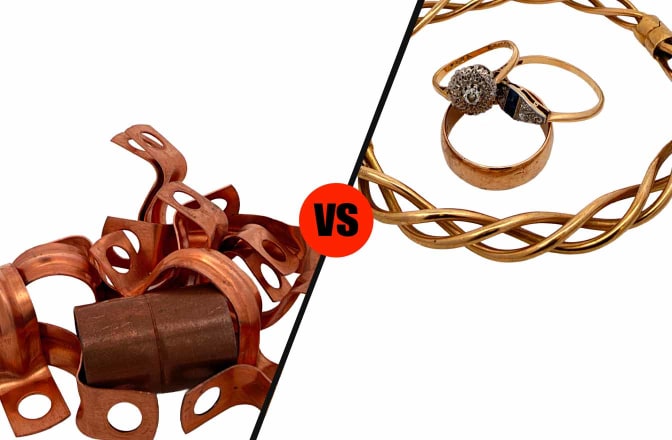
A scrap metal dealer buying old copper pipe faces far stricter rules than a business buying your gold. That's because the Scrap Metal Dealers Act 2013 specifically leaves gold and silver out.

| Rule | Scrap metal dealer | Gold buyer (England and Wales) |
|---|---|---|
| Needs a council licence | Yes | No |
| Can pay you in cash | No, it's a criminal offence | Yes |
| Must check your ID | Yes, every time | Only for cash deals of £10,000 or more |
| Must record every purchase | Yes | No specific rule |
Gold is worth thousands of times more per gram than copper. Yet the person buying your wedding ring faces fewer checks than the person buying your old boiler.
What happened the last time a regulator stepped in
Between 2009 and 2011, the Office of Fair Trading (OFT) investigated five postal gold buying companies. Its main worry was that people were sent a payment rather than a quote. If they didn't reject it in time, their silence was treated as a yes, and their gold could be melted down.
The OFT was also concerned about "top price" claims that didn't explain they were based on scrap value. It wanted clearer information on insurance and on what happened to gemstones.
Three companies signed legally binding promises (called undertakings) to change how they worked, and two left the market. The companies didn't admit breaking the law, and no court ruled on it. The OFT closed the case in February 2011, and the CMA now holds the file.
This tells us two things. Consumer law does reach gold buyers. But it took over a year, it only covered five firms, and it never tackled the low prices sellers were being paid.
Why misleading claims are still common
The OFT's 2011 promises only applied to the firms that signed them. New gold buyers have started up since, and the same kind of claims are back.
Today, some buyers advertise themselves as "the UK's highest paying gold buyer" or "the UK's most trusted gold buyer". In our own tests in June and August 2026, one buyer making those claims offered 53.7% and 52.6% of the gold's market value. You can see the full results of our tests.
The Advertising Standards Authority (ASA) can rule that an advert is misleading and tell the business to change it. But it can't fine anyone, and it only steps in after an advert has run, usually once someone complains. Businesses that keep breaking the rules can be referred to Trading Standards.
So a big claim in an advert proves nothing. What matters is the price per gram a buyer will actually pay you.
What "Trading Standards approved" really means
Buy With Confidence is an approved trader scheme run by council Trading Standards teams. Before a business can join, Trading Standards visits it and checks things like its complaints history, paperwork and website. Members are then monitored.
It's a voluntary scheme, not a licence. A gold buyer doesn't need it to trade, and it doesn't guarantee you a good price.
We joined because we think sellers deserve to know who they're dealing with. In 2022, Gold Traders became the first precious metals company in the UK to be approved through the scheme. You can check any business on the Buy With Confidence website.
We're also members of the British Numismatic Trade Association (BNTA), a trade body with its own code of conduct. Again, that's something a business chooses to do, not something the law asks for.
How to protect yourself before you sell
Because buyers don't have to show their rates, offers for the same gold can be miles apart. In June 2026, Wiltshire Trading Standards took the same gold (12.5g of 9ct and 24.2g of 18ct, worth more than £2,200) to four buyers. Here's what they offered.
| Type of buyer | First offer |
|---|---|
| Mobile buyer in a campervan in a car park | £1,122.57 |
| Gold buying shop | £1,191.00 |
| High street jeweller | £1,500.42 |
| High street pawnbroker | £1,880.00 |
Using our published prices, we worked out that Gold Traders would have offered £2,057.82 for the same gold. You can read the full Trading Standards gold test.
Until the law changes, these checks are your best protection.
- Ask for the price per gram first. An honest buyer can tell you what it pays per gram for each carat. If a buyer won't say, walk away.
- Compare it with the market. Today we're paying £33.54 per gram for 9ct gold and £67.09 per gram for 18ct. That's 91.9% of the live market value. You can see all our gold prices or use our scrap gold calculator.
- Get more than one valuation. That's Wiltshire Trading Standards' advice too. Never feel pushed into taking the first offer.
- Get the offer in writing. It should show the weight, the carat and the price for each item.
- Selling by post? Check what happens if you say no. Your items should stay whole until you accept, and the return should be free. Be wary of any buyer that sends a payment instead of a quote.
- Check who you're dealing with. Look the company up on Companies House, and read its reviews on independent sites.
- Ask if auction would pay more. Signed pieces, good gemstones and antiques can be worth more than their gold. We'll always tell you if we think auction is the better route.
If you're buying gold rather than selling
The rules aren't much tighter when you buy gold. Physical gold isn't a regulated investment, so there's no Financial Ombudsman or compensation scheme if something goes wrong with a dealer.
That's why adverts for gold investments must make clear the market isn't regulated. If a dealer tells you gold is a "regulated investment", be careful.
Choose a dealer with a long track record, a real address you can visit, and membership of a trade body such as the BNTA. Gold Traders is an Official Partner of The Royal Mint, and we buy our brand new coins and bars directly from them. You can browse our gold coins and bars.
Is this going to change?
I hope so, and I'm doing what I can to make it happen. In April 2026, I launched a campaign asking Parliament for five targeted protections:
- Mandatory price transparency before any transaction
- Regulation of postal buying services
- Regulation of travelling buying events
- A cash threshold ban
- Identity verification obligations for all sellers
You can read the detail behind each one in why we're campaigning for change. None of them would require us to change a single thing about how we work at Gold Traders.
Here's where things stand.
- Support from my MP. Sarah Gibson, the MP for Chippenham, backs the campaign and has pledged to apply for a Westminster Hall debate. That's a debate in Parliament where a government minister has to respond.
- A question in Parliament. Damian Hinds MP asked the Government whether gold buyers should have to show the price they pay per gram. The minister said existing law bans unfair practices and misleading prices, but that the department hadn't looked at the idea.
- A Parliament petition. You can sign my petition to regulate the precious metals buying market until 24 February 2027. At 10,000 signatures the Government will respond, and at 100,000 it will be considered for debate.
That answer from the minister sums up the gap. The law can punish a misleading price, but nothing makes a buyer tell you its price in the first place.