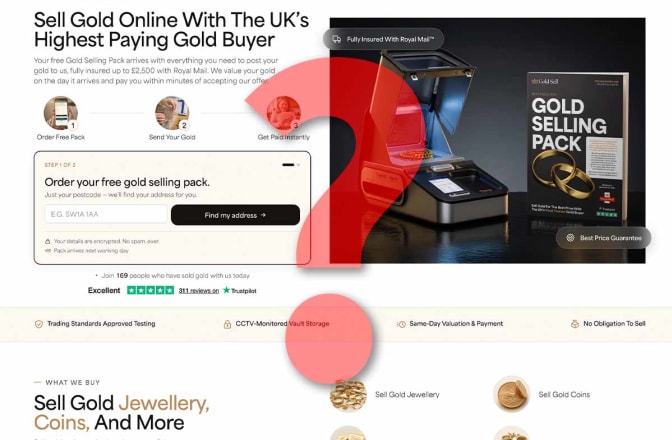
GoldSell (goldsell.co.uk) is a real registered company, GS Metals Ltd. But several of the trust signals it uses to reassure sellers don't hold up. The MoneySupermarket endorsement it quotes has been confirmed false by MoneySupermarket itself, other endorsement logos appeared without evidence and were then removed, and parts of its homepage present made-up activity as if it were real. And despite branding itself the "UK's highest paying gold buyer", GoldSell pays nowhere near the highest rates: in our test, its first offer was just 53.7% of the gold's spot value, around £254 below the market rate on the item tested and far short of the 85-90% or more a fair buyer should pay. Treat its claims with caution, and check them before you sell.
If you've searched for how to sell your gold online, you have almost certainly seen GoldSell. It's currently one of the most prolific paid advertisers in this market, so its ads sit at the top of the page for all sorts of "sell my gold" searches.
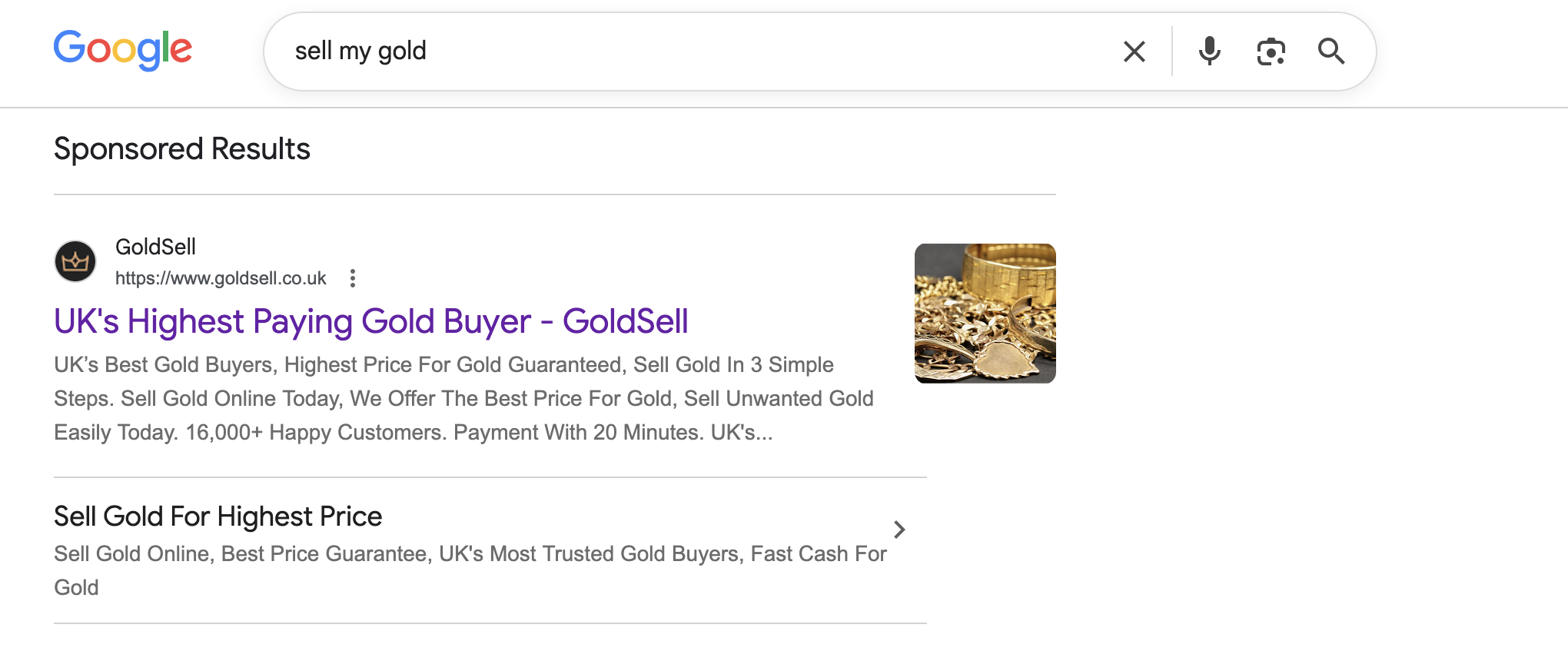
The site looks reassuring. It points to a strong Trustpilot score, claims of independent endorsement, and lots of numbers that suggest thousands of happy customers.
We deal with gold every day, so we took a closer look at those trust signals. What we found raised enough questions that we think anyone thinking of posting their gold to GoldSell should read this first.
Before we start, we want to be upfront. We're a gold buyer ourselves, so we have a commercial interest in this market. This is not about attacking a rival. It's about honesty in an industry where sellers are often trusting a stranger with something valuable.
First, who runs GoldSell?
GoldSell (goldsell.co.uk) is a trading name of GS Metals Ltd, a company registered in England and Wales with company number 16077167. GoldSell states this on its own website, which is exactly what a genuine business should do.
GS Metals Ltd was incorporated on 13 November 2024, so it's a very new company. Its registered office is a serviced office suite in Highgate, London, and the site describes its only address as "by appointment only". There is no shop you can walk into.
That matters when you look at some of GoldSell's own claims. For a company incorporated in late 2024, its website markets "over 75 years of combined experience". That may be meant to describe its team rather than the business itself, but with no named valuers and no track record given, it's not something a seller can actually check. GoldSell's two named directors were born in 1996 and 2001, and the site names no other valuers, so it isn't clear where "over 75 years of combined experience" comes from.
The MoneySupermarket "independent test" that never happened
This is the part that concerned us most.
We placed an order with GoldSell on 14 July 2026 to see the process for ourselves. When we did, the order confirmation page displayed a MoneySupermarket badge. Next to it, GoldSell claimed that MoneySupermarket had run an "independent test", sending identical gold to 10 leading UK postal gold buyers to see who paid the most, and that GoldSell had "come out on top" with the highest payout. The exact wording is shown in the screenshot below.
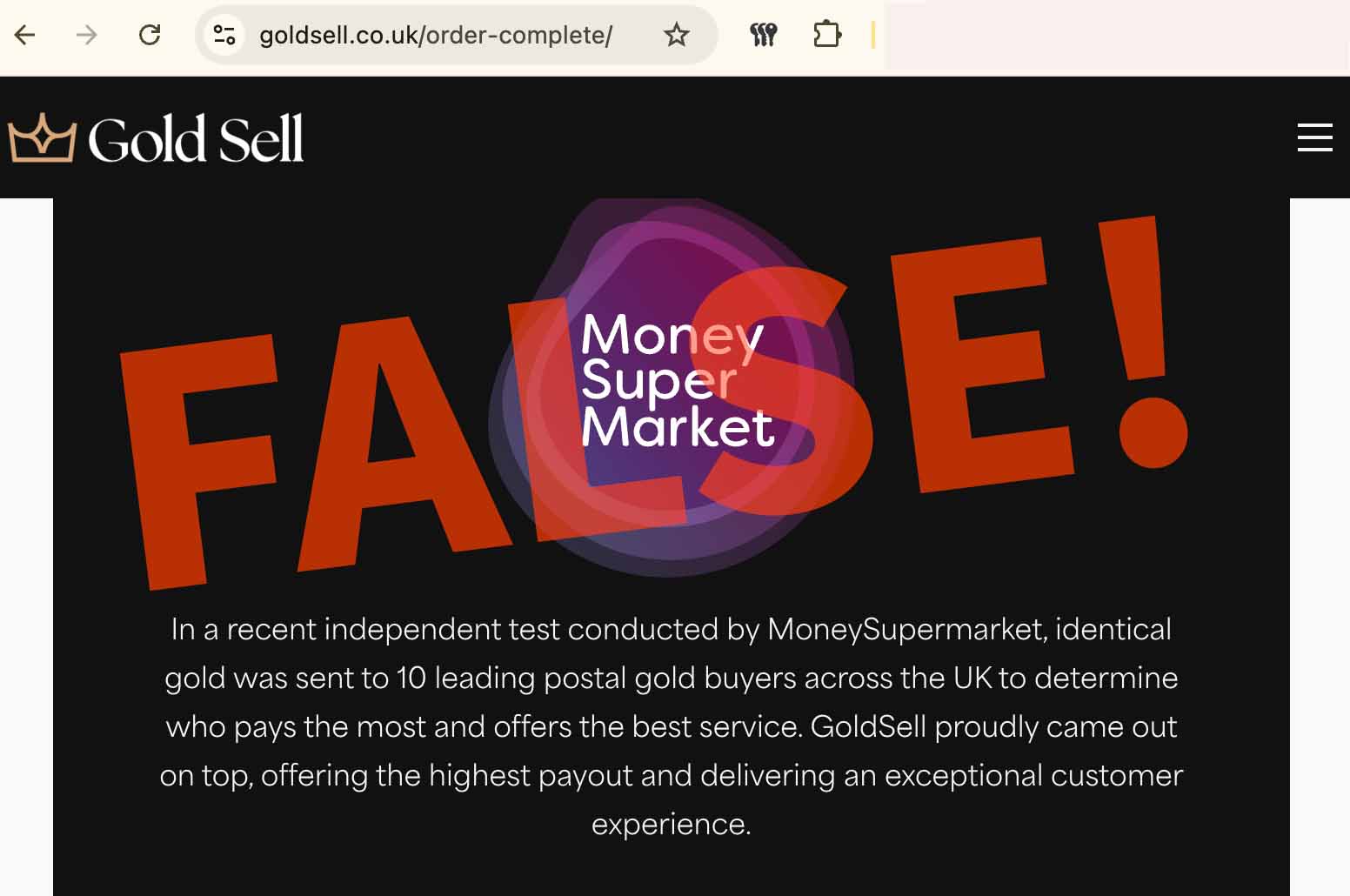
That is a powerful claim. MoneySupermarket is a household name, and an "independent test" win from a trusted comparison brand is exactly the kind of thing that makes a nervous seller feel safe.
So we asked MoneySupermarket directly. Their press office replied to us in writing, and their answer could not have been clearer:
"I can confirm that we haven't undertaken any such test."
MoneySupermarket has passed the matter to its legal team, who have asked us for further details. In other words, this is not simply a claim we could not verify. It's a claim the named company has told us, in writing, is not true.
Since we began looking into this, GoldSell has removed that MoneySupermarket badge from the order confirmation page. But the claim itself has not gone away. At the time of writing, it still appears in the FAQ sections of GoldSell's product pages, including its 9ct gold page. Under the question "How do I know I'm getting the best price for my scrap gold?", GoldSell again tells sellers that MoneySupermarket ran an independent test in which it offered the highest payout and best service against 10 leading postal gold buyers. The full FAQ wording is shown in the screenshot below.
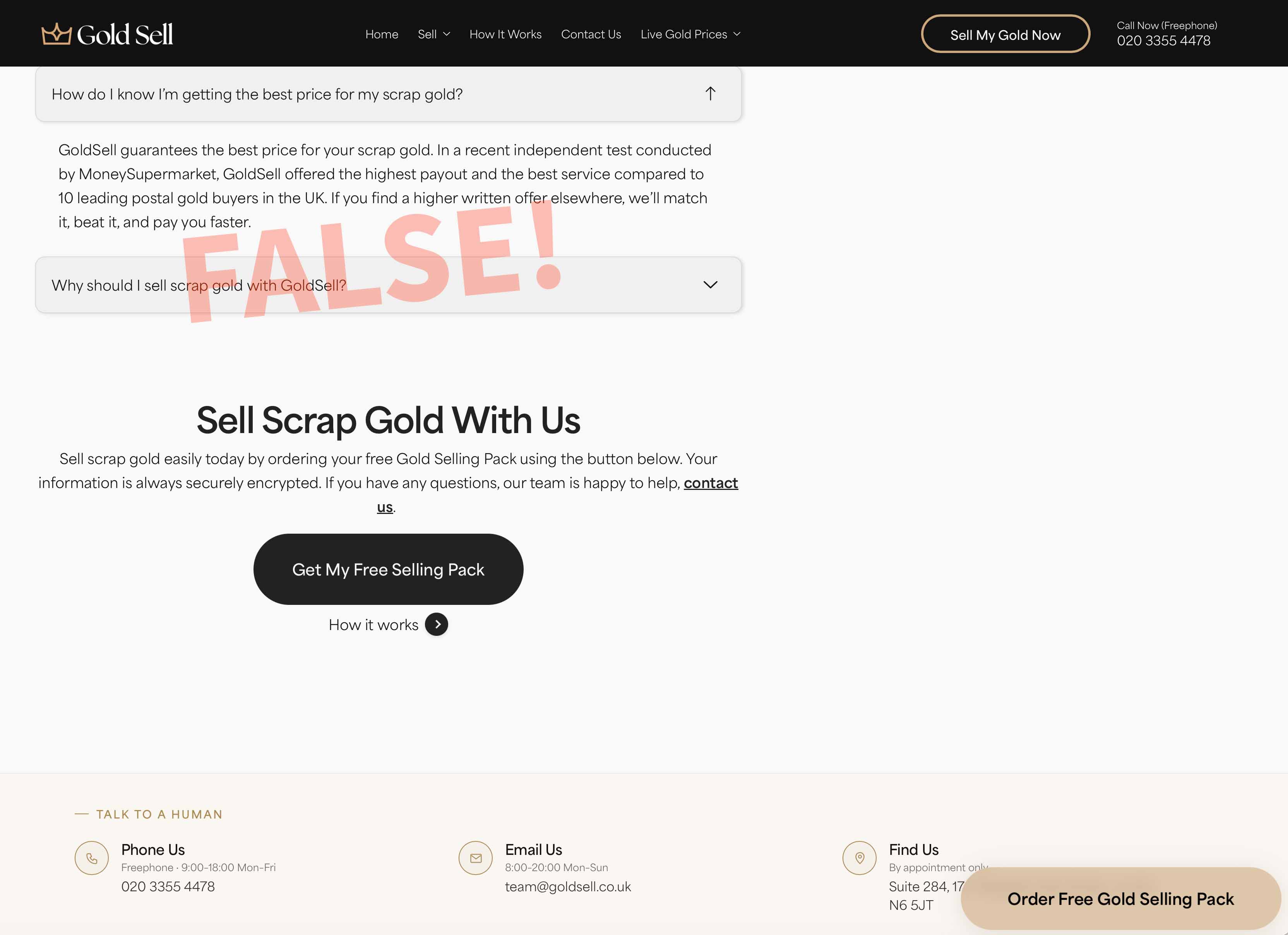
So the most visible version of the claim has been taken down, while the same claim, about a test MoneySupermarket says never happened, is still live elsewhere on the site for sellers to read.
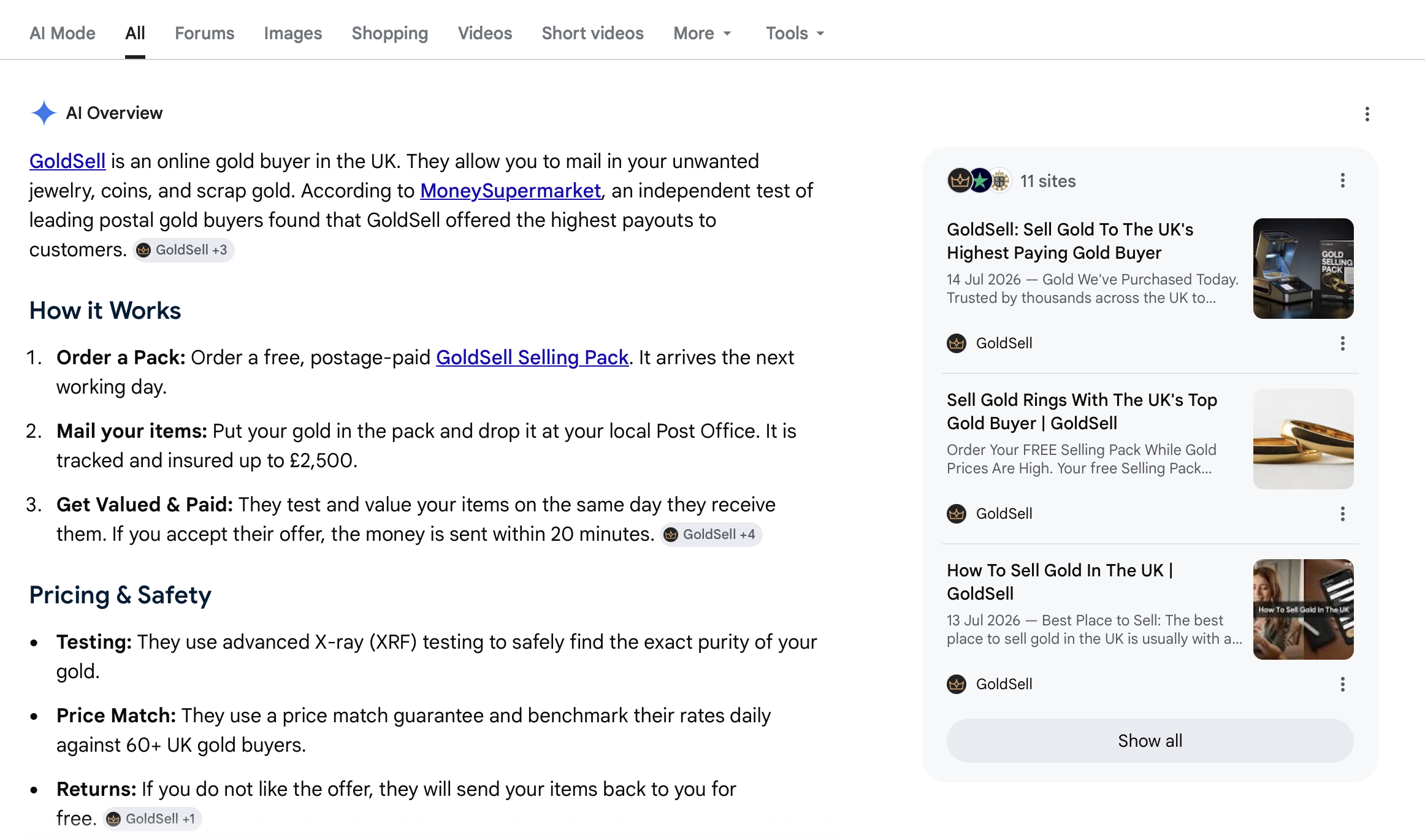
There's one more thing worth knowing. Because the claim is written on the site as though it were fact, Google's own AI Overview has started repeating it to searchers, presenting a test that MoneySupermarket says never happened as if it were established truth. That's how a single fabricated badge can quietly spread and help bring unearned trust.
The MoneySavingExpert and Forbes logos that quietly disappeared
The MoneySupermarket claim isn't the first time GoldSell has leaned on a trusted name.
An early version of the GoldSell homepage, captured on 28 November 2024 (about two weeks after the company was set up), carried an "Endorsed By" logo strip. It featured the logos of MoneySavingExpert, Forbes, MarketWatch and Google, sitting alongside Trustpilot.
A quick note on that link. The archived page may not load fully in your browser today, as some of its images no longer display. The "Endorsed By" section naming those brands is still preserved in the saved copy of the page, which is how we were able to record exactly which logos appeared.
Those logos appeared with no link, no citation, and no named article behind any of them. We have not been able to find any evidence that MoneySavingExpert or Forbes ever tested, reviewed or endorsed GoldSell.
By early 2025, the whole "Endorsed By" strip had been removed from the site. The logo image files have since been deleted from GoldSell's own server too. Each one now returns a "404 not found" error, so the images survive only in web archives. We can't say for certain why they were removed, and we're not going to pretend we know.
What we can say is this. When a website displays endorsement logos from major brands with nothing to back them up, then quietly takes them down, and when a separate endorsement on the same site (MoneySupermarket) has since been confirmed by that company to be false, we think sellers are entitled to treat those earlier logos with real caution too.
A Trustpilot review count that doesn't add up
GoldSell relies heavily on Trustpilot, and a strong star rating is one of the first things a seller looks for. Here, it's only fair to say the site has since put things right.
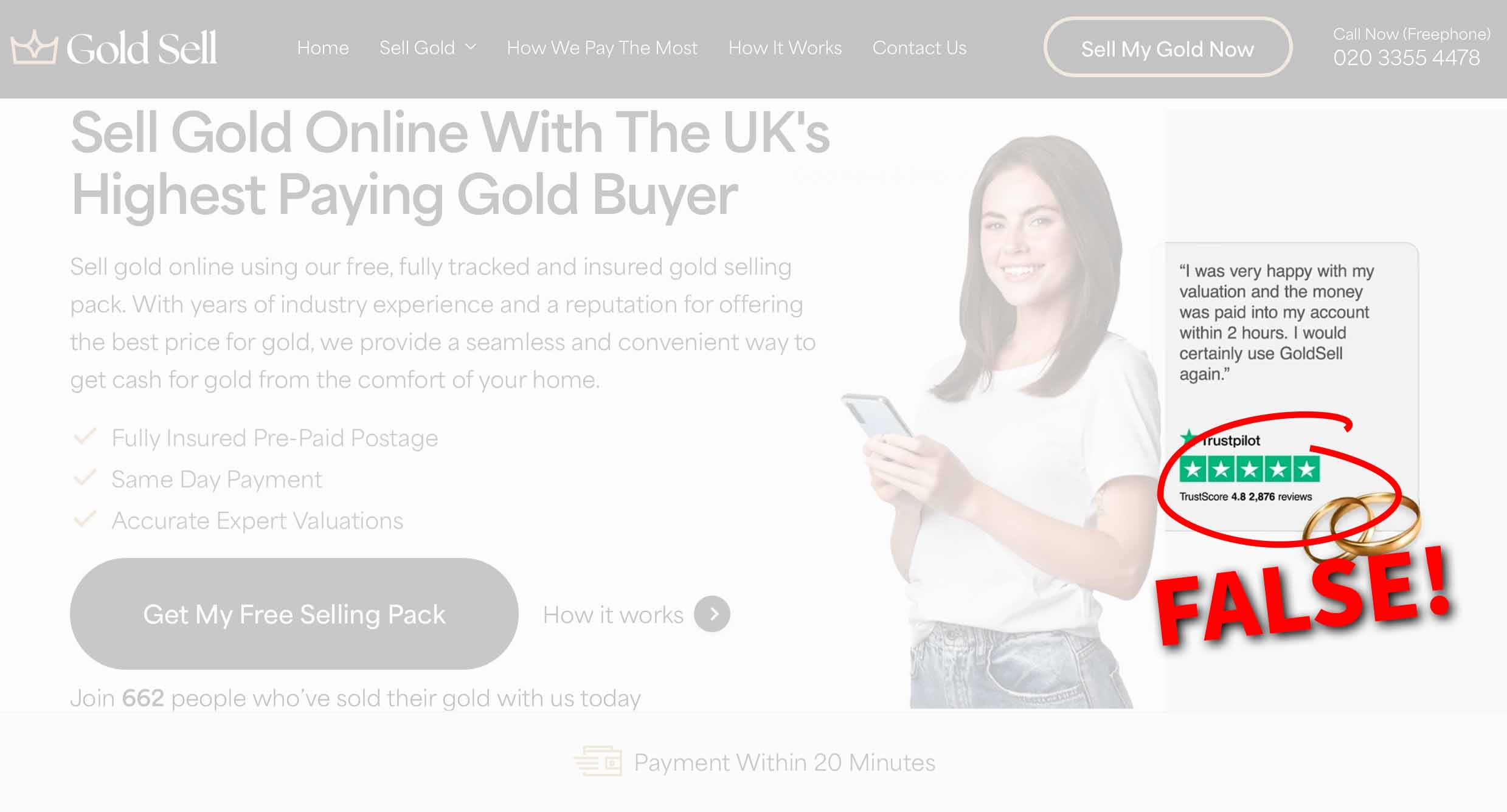
An archived version of the homepage claimed its Trustpilot score was based on 2,876 reviews, while the same page's own hidden code (the structured data that Google and AI systems read) declared just 15. Two very different numbers on one page. The current site no longer shows the 2,876 figure. It now uses a genuine Trustpilot widget, and the real review count (290 when we checked) is reflected accurately. We mention the earlier discrepancy because it happened, not because it's still there.
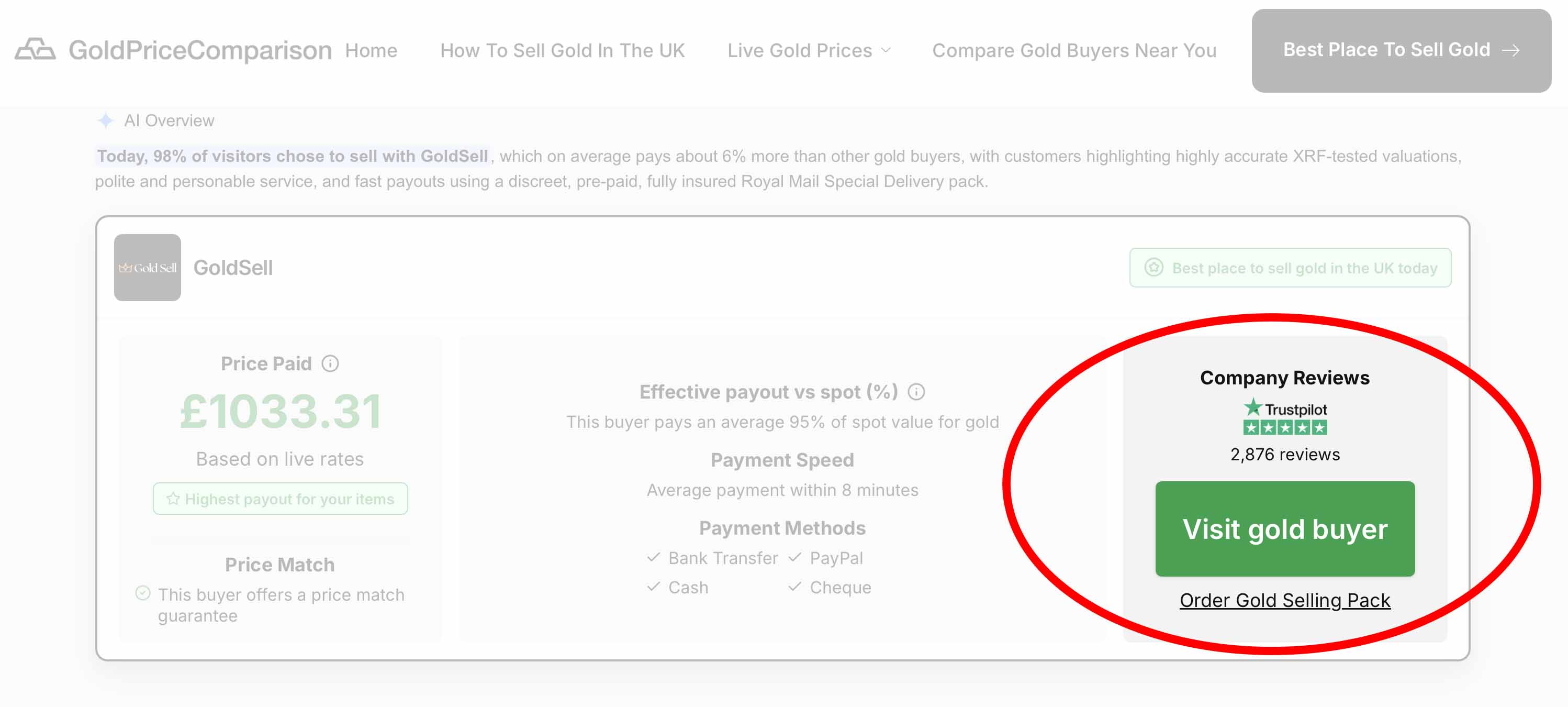
There's one twist, though. The discredited 2,876 figure hasn't disappeared everywhere. At the time of writing it was still on display at goldpricecomparison.co.uk, a site that presents itself as an independent way to compare gold buyers but, as we set out in a separate investigation, points every route to GoldSell. The inflated number GoldSell has dropped from its own site is still doing its work on the site that does the recommending.
A "live" sales feed that isn't live
Trust signals aren't only logos and star ratings. GoldSell's homepage also uses movement to look busy and popular.
Under the heading "Gold We've Purchased Today", the homepage shows a scrolling feed of named sellers, amounts paid, and how long ago each sale supposedly happened (for example "Sally - £997.55 via Cheque").
At first glance it looks like a live record of real customers. Look closer and the picture changes. The names, amounts and payment methods aren't typed in by customers at all. They're served to the page by GoldSell's own website through a behind-the-scenes feed, and they're swapped over time. The fifteen names on show one day (Priya, Gary, Tony and so on) were replaced by a completely different fifteen the next (Sally, David, Zara and so on).
Two things give the game away. First, the photos never change. The same fifteen pictures of piles of gold, uploaded to the site back in December 2024, appear in the same order every single day, whatever names and amounts are shown beside them. And these aren't generic decoration: each photo carries a hidden caption (the alt text written into the code) that reads "Gold purchased from [name] for [amount] via [method]". So the very same December 2024 image is labelled as the gold bought from one named person today, and as the gold bought from a different named person tomorrow. Real purchases from real people would not come with the same fifteen recycled photos on rotation.
Second, the timings are engineered to look fresh. Each "sale" is set a short while in the past, so the feed always reads as though gold has just been bought, and the "time ago" is recalculated by the page as you watch. Across a day the same set simply ages, drifting from "1 to 2 hours ago" in the morning to "5 to 6 hours ago" by the afternoon, before a fresh set takes its place.
The site's code even carries a hardcoded backup list of fifteen invented payouts (for example "David, £1,002.83, 29 minutes ago") to display if the main feed fails. Whichever version a visitor sees, this is a feature built to look like busy, live trading, not a genuine record of it.
The "sold today" counter is invented too
Just above the order form, the homepage shows a line reading "Join [number] people who have sold gold with us today" (388 when we looked). It's the classic "lots of people are doing this" nudge.
When we first looked at this, we were careful to say we couldn't prove the number was false, because a figure like this could, in theory, come from a real sales system. The page's code settles the question. A script sets a starting figure between 100 and 150 at the start of each day, then steadily climbs it towards a target between 400 and 550 by the end of the day. The exact figures are fixed by the calendar date, so the number is the same for every visitor and simply follows the clock. It isn't counting customers at all. It's generated by the page, with no link to any real sales total.
There's a ceiling built in, too. The number can never climb more than eight past that day's target, so on the day we checked it could not pass 490, and on no day can it ever top 558, however many people really sell. You can sanity-check the figure on screen yourself: it's roughly the day's starting number, plus its climb towards the target, scaled by how far through the day you are. A real count of customers doesn't run to a formula, and it doesn't have a maximum.
On its own, a decorative counter is a small thing. But an invented counter, sitting above a feed built to look live, on a page that also carries an endorsement its named company says is false, is a pattern rather than a one-off.
And then there's the price
Trust signals are supposed to reassure you that you'll get a fair deal. So the fairest test of all is a simple one: what does GoldSell actually pay?
We checked. As part of our ongoing gold buyer price comparison, we sent GoldSell 15.2 grams of 9ct gold on 20 June 2026 and recorded the first offer, with no negotiation, because the first offer is what most sellers actually accept.
The offer was £293.17. At the live spot price that day, the same gold was worth £547.17. That works out at 53.7% of spot value, around £254 below the market rate for that gold.
That's one test on one day, not a claim about every transaction. But a real first offer of 53.7% is a long way from the "highest payout" the site's badges promise. As a general guide, any seller should be aiming for at least 90% of spot value.
This is a familiar pattern
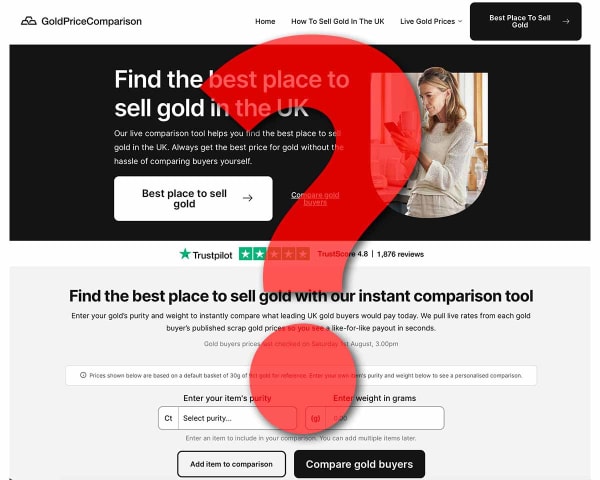
If this feels familiar, that's because we've seen a very similar playbook before. GoldSell is also the single buyer that every route through goldpricecomparison.co.uk points to, a "comparison" site that displayed endorsement logos three separate organisations told us were never given.
You can read that investigation here: is goldpricecomparison.co.uk really an independent gold comparison site?
So, can GoldSell be trusted?
That's for you to judge, and we'll be careful about what we claim. We can't tell you how GoldSell treats every customer, and plenty of its Trustpilot reviewers report a smooth experience.
What we can tell you is that several of the trust signals used to reassure sellers do not hold up when you check them. One endorsement has been confirmed false by the company named in it. Others appeared without evidence and were later removed. A review count didn't match the platform it pointed to. And parts of the homepage present made-up activity as if it were live.
When that many trust signals turn out to be questionable, our honest view is that the safest thing to do is not to take any of the site's claims on trust, including its "highest payer" promise, without checking them yourself first.
How to protect yourself when selling gold
None of this means you can't sell gold safely online. It just means you should judge any buyer, including us, on evidence rather than badges. A few simple checks put you back in control:
- Find out who you're dealing with. A genuine buyer will give you a company name, number and address without you having to dig for it.
- Ask for the actual price per gram. A live spot price on a screen is not the rate you'll be paid. Ask what you'll actually receive per gram for your purity, in writing, before you send anything.
- Be careful with "we pay the most" claims. If a claim can't be checked against a published, like-for-like rate, treat it with caution.
- Check that logos are real. If a site shows an endorsement, you're entitled to ask the named organisation whether it's genuine. We did, and the answer was revealing.
At Gold Traders, we publish both the live market price and the actual rates we pay, so you can make an informed decision before you visit or post anything. We were also the first precious metals company in the UK to be accredited by Trading Standards through the national Buy With Confidence scheme.
Why we keep writing about this
We didn't go looking for a fight. We went looking because this is the sort of thing that happens in a market with no rules.
The UK's precious metals buying market is currently unregulated. There's no legal requirement for a gold buyer to tell you, plainly and in advance, the actual rate they'll pay, and no rule against dressing a website up with trust signals that don't stand up to a second look.
That's why we're leading a campaign calling on Parliament to introduce basic consumer protection for this market, including mandatory price transparency before any transaction, and proper rules for postal gold buyers.
Jon White, founder of Gold Traders, said:
"People trust these sites because they look busy, popular and endorsed by names they recognise. When an endorsement turns out never to have been given, and the numbers on the page don't match reality, it's ordinary sellers who lose out. That's not a fair market, and it's exactly why we're asking Parliament to bring in some basic rules."
The bottom line
GoldSell is a real, registered company, and we're not going to pretend otherwise. But a website is only as trustworthy as the claims it makes, and too many of GoldSell's claims fall apart when you check them.
If you're selling gold, look past the badges. Ask who you're dealing with, ask for the real rate per gram, and choose a buyer who's happy to tell you both.
About the author: Jon White is the owner of Gold Traders, the UK precious metals buying business he founded in 2008. He has spent eighteen years buying and selling gold, silver and coins, and campaigns for mandatory price transparency in the UK's precious metals market. Under Jon, Gold Traders became the first precious metals dealer in the UK to gain Trading Standards accreditation through their national Buy With Confidence scheme.