This week, BBC Watchdog turned its attention to one of the UK's best-known postal buying companies, Vintage Cash Cow.
The investigation, presented by Matt Allwright on Wednesday's edition of The One Show, raised serious questions about the company's offers, its handling of customers' items, and what happens when things go missing in the post.
For anyone thinking about selling gold, silver, or jewellery, the segment is essential viewing. It also speaks directly to a campaign we're been running: the urgent need for better consumer protection in the UK's precious metals buying market.
What Watchdog Found
Vintage Cash Cow describes itself as the UK's number one online platform for selling pre-loved items in bulk. Customers send their items via courier, receive a valuation, and can either accept the offer or ask for their items back.
That is how it is supposed to work. According to Watchdog, the reality has been very different for some customers.
The programme spoke to three women who had sent valuables to Vintage Cash Cow and were left distressed by the outcome.
Lynn from Tamworth
Lynn sent around 150 items in October 2025, including watches and jewellery that had belonged to her parents. She hoped to raise enough to split between her grandchildren.
The offer she received was £140. She rejected it.
When her parcel came back two months later, Lynn says around 20 items were missing, including an Omega watch that had belonged to her mother. A BBC valuer estimated one silver watch alone could have been worth up to £1,600.
Beverly from Dorset
In February 2026, Beverly sent items including a ring from her late mother and a Claude Valentini watch that had belonged to her late husband. She had recently been made unemployed and was struggling with bills.
Vintage Cash Cow offered £20. When her items were returned, the ring box and the watch box were both empty.
A BBC valuer estimated her items could have been worth around £300. The company told Beverly it had never received the missing items and offered no compensation.
Sue from Essex
Sue sent seven items in October 2024. When she rejected the offer and asked for them back, the items returned to her were not hers.
Vintage Cash Cow admitted it had lost her parcel and offered £50 in compensation. A BBC valuer estimated her items were worth around £800.
The Legal Point
The programme spoke to legal expert Jasper Grigson, who explained that when a business takes possession of someone else's goods, it has a duty of care under the law of bailment.
His view was clear: companies should be compensating customers in full for the true value of items that go missing.
Vintage Cash Cow's Response
In fairness to the company, Vintage Cash Cow told the BBC that 300,000 customers have trusted it with over a million boxes and that it holds a 4.4 out of 5 rating from over 30,000 Trustpilot reviews.
It said issues of this nature are extremely rare, that it continues to improve its service, and that enhanced insurance of up to £10,000 is available on request at no additional cost.
It also confirmed it had contacted Lynn and Sue to try and put things right.
Why This Matters
We have no commercial axe to grind with any one company. But the Watchdog feature highlights something we have been saying for years.
The UK precious metals buying market is unregulated. There is no requirement for postal buying services to be transparent about the rates they pay. There is no statutory cooling-off period. There are no mandatory standards for how a customer's items must be handled, insured, or returned.
If you're a seller, you're largely on your own.
Our Campaign for Regulation
Earlier this year, Gold Traders launched a campaign calling for proportionate, targeted regulation of the precious metals buying market. We have written to MPs, Trading Standards, and the Police and Crime Commissioner for Wiltshire.
Two of our proposals are directly relevant to the kind of harm Watchdog has highlighted:
Mandatory price transparency. Any buyer should be required to publicly disclose the rate they pay, expressed as a price per gram for the purity of the metal in question, before a transaction begins.
Regulation of postal buying services. Any business operating a postal precious metals buying service should be required to provide a specific written indication of the rate the seller can realistically expect to be paid, before they are asked to send items. Simply displaying a live spot price, without clearly stating the actual price per gram paid to the seller, should not count as proper disclosure. The free return of items must also be guaranteed if an offer is declined.
These are simple, proportionate measures. Well-run businesses already do all of this as standard. Regulation would not burden them. It would simply raise the floor for everyone else.
Watching that Watchdog piece was difficult. These are people who trusted a company with items that mattered to them, often things linked to people they had lost, and they have been left out of pocket and out of hope. This is exactly why we have been campaigning for regulation. Postal buying services need clear rules, real accountability, and a duty of care that matches the value of what they hold.
Jon White, Owner of Gold Traders
How to Sell Gold Safely
If you are thinking about selling gold, silver, or jewellery, here are the steps we would recommend taking before you part with anything.
1. Ask what they pay per gram
This is the single most important question you can ask any gold buyer.
A reputable buyer will be able to tell you exactly what they pay per gram, for the purity of the gold you are selling (9 carat, 14 carat, 18 carat, and so on). They will publish those rates openly on their website or be happy to quote them by phone or email.
If a company cannot, or will not, give you a clear price per gram, it is almost always because their rates are low. Walk away.
2. Be wary of headline spot prices
Some buyers display the live market spot price prominently, in a way that can make it look like that is what you will be paid. It is not.
Spot is what a 999.9 fine bar of gold trades for in the global market. The price for your 9 carat ring will be far lower. The only number that matters is the actual price per gram for your specific item.
3. Choose buyers who are accountable
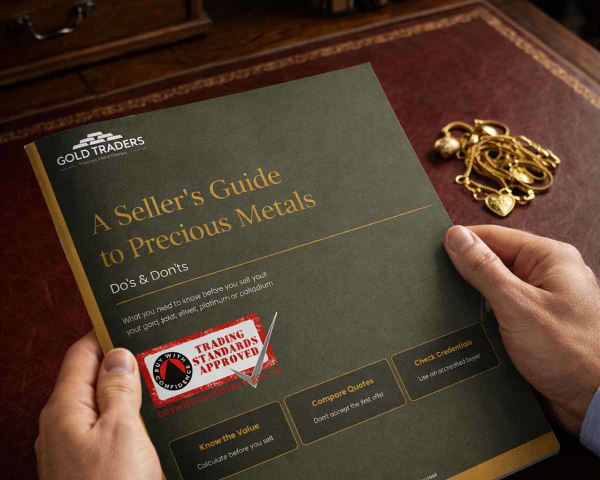
Look for accreditations that mean something. Gold Traders is a Trading Standards Buy With Confidence accredited business, the first precious metals company in the UK to receive that accreditation.
We are also an Official Partner of The Royal Mint®, and the only such partner in the South West of England.
These accreditations come with ongoing scrutiny. If a buyer has none of them, ask yourself why.
4. Try in person where possible
If you can visit a buyer in person, do. You can see the staff, see the equipment, watch your items being weighed and tested, and walk away with cash the same day if you accept the offer.
Postal services have their place, but face-to-face is always the safer option.
5. Read the small print before you post
If you do choose to post your items, read the terms and conditions carefully. Pay particular attention to:
- The default level of insurance cover (it may be far lower than the value of your items)
- Whether enhanced insurance is available, and how to request it
- What happens if you reject the offer
- What happens if items go missing
- How long the return process takes
If anything is unclear, ask the company directly before posting. If they cannot or will not give you a straight answer, that is your answer.
Want the Complete Guide?
The five tips above are the essentials. For a deeper walk-through covering every stage of the process, from working out the carat of your gold to choosing between in-person, postal, and auction routes, we have put together a more detailed resource.
Read our complete guide on how to sell gold for everything you need to know before you part with anything valuable.
Selling With Gold Traders
We have been buying precious metals for over eighteen years from our base in Royal Wootton Bassett, Wiltshire, with a second branch in Bodmin, Cornwall.
You can visit us in person, post your items using our fully insured postal service, or get an instant online valuation through our website. Our rates are published openly, expressed as a price per gram for every common purity of gold and silver, alongside the live market spot price for comparison.
If your items are likely to achieve a better price at auction, we will tell you so and refer you to our sister company, RWB Auctions, also based in Royal Wootton Bassett.
Honest, transparent, and accountable. The way every precious metals business should operate.
Thinking of selling gold or silver? Get a free, no-obligation valuation by visiting our valuation page or calling us on 01793 230331. Our published rates are updated daily and available to view before you commit to anything.