One of the best known precious metals, Silver has a rich history. Silver has been used by man for thousands of years and, in ancient times, it was considered to be the second most valuable precious metal with Gold being the first. This is very interesting when you consider that the value of silver has never achieved a price of more than 1/10th of the gold price. In this article, we take a look at some interesting facts abouts silver.
Silver has the chemical symbol Ag, a shortened form of its Latin name, Argentum, which has been translated to mean "white" or "shiny". The word 'Silver' originates from the old English Anglo-Saxon word 'seolfor'.
Silver in the Holy Books
While silver was largely used for ornaments, jewellery and utensils, it has also been used for trade currencies. The biblical account of Jesus Christ's betrayal remarks that Judas Iscariot betrayed Christ for 30 pieces of silver, the book of Genesis describes silver as already being used by early people and countless other biblical and historical references point to trading being handled with silver as the currency from the fourth millennium B.C. Silver also found it's place into non Christian religious records. The Muslim holy man, Muhammad, is said to have worn a silver signet ring, making silver jewellery one of the few accepted forms of ornamentation for men of the Islamic faith.
The Ancient & Antibacterial Properties of Silver
Since silver possesses antibacterial properties, it has been used for medicinal purposes since the time of the Ancient Greeks. The Ancient Greek and Roman people used silver to prevent infection, and the stability of the Roman economy depended upon the silver supplies mined at a rate of about 200 tonnes per year, creating a Roman silver supply of nearly 10,000 tonnes in the 2nd century A.D. During the Middle Ages, the antibacterial properties of silver were also used to disinfect water supplies and protect food supplies during long-term storage. Around this time, the European people also developed the technique of using silver to treat burn and wound victims, as well as to dress for their injuries. By the 19th century, sailors had discovered that placing silver coins into the barrels of water and wine they carried would keep these perishable commodities pure from contamination by bacteria, a trick that was then adopted by the early settlers of the American west. In fact, this use for silver has proven to be so effective that, in 1920, the U.S. Food & Drug Administration (US FDA) approved silver solutions as food safe antibacterial agents.
The Current Uses of Silver
Although modern man still uses silver for its traditional usage in jewellery, ornaments, silverware, tableware and coins, we haven't stopped with just the common uses. Modern science has also discovered the uses of silver for the manufacture of mirrors, clothing, electrical circuitry, photography, dentistry and medical uses, as well as its catalytic properties, which lead to silver use in control rods for nuclear reactors and industrial applications. The high electrical conductivity of this metal has made it useful for electrical applications, particularly audio cables. Still, it has largely been avoided due to the high cost and the problems associated with tarnishing, the oxidation of silver when it comes into contact with air or water containing ozone, sulfur or hydrogen sulfide. Despite these detractors, 13,540 tonnes of silver were used to build magnets during World War II to enrich uranium because of the short supply of the more economical copper.
Where is silver found?
While silver is found on every continent of the world, most silver being mined today is found in Peru and Mexico, where the metal has been mined since 1546. Silver is found in its pure form in nature. It also can be found alloyed with gold and other metals or in the presence of minerals, such as argentite and chlorargyrite. Most silver being mined today is a by-product of other metals' production and refining processes, such as copper, gold, lead, and zinc.
Some Interesting Facts About Silver
- Silver is classified as a "Transition Metal" and is located in Groups 3 - 12 of the periodic table. A Transition Metal is ductile and malleable and can conduct electricity and heat.
- The atomic number for silver is 47, and its atomic mass is 107.8682 amu. A cubic centimetre of pure silver weighs 10.5 grams (0.3704 ounces, 0.3376 troy ounces).
- Silver melts at 961.93°C and boils at 2212.0°C.
- The modern Olympic Gold Metal is made of Sterling Silver, which is then plated with 6 grams of pure gold.
- British silver coins minted before 1920 are Sterling silver. Crowns, half crowns, florins, shillings and sixpences minted between 1920 and 1946 contain 50% silver.
- Silver is not toxic, but almost all silver salts are poisonous.
- Silver Iodide is used to seed clouds, a process that brings rain to dry regions during drought.
- Some mirrors are made by a process called silvering glass. As a byproduct of this process, silver fulminate is sometimes produced. Silver fulminate is a very powerful explosive.
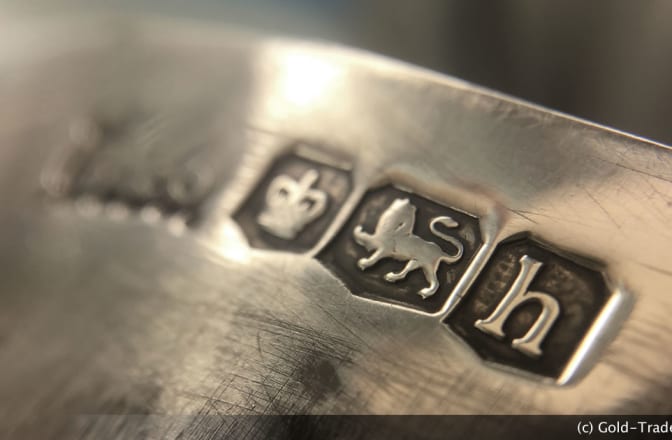
- Sterling Silver is 92.5% pure. Items made of sterling silver are stamped with the word "Sterling", the number "925," or a combination of the two.
- The transitional lenses in your spectacles are made with silver halide. These lenses can change light transmission from 96% to 22% in less than one minute and they effectively block 97% of the damaging ultraviolet rays from sunlight. These changes can be reversed over and over again.
- Silver is used in the production of cloth that is resistant to the effects of mildew and bacteria.
- It also possesses the highest thermal and electrical conductivity of any known metal.
- Approx 20,000 tons of silver is mined every year.
- Silver is used to represent the twenty-fifth wedding anniversary.
Other relevant pages about silver:
- View our scrap silver prices per gram and receive an instant valuation for your unwanted silver coins and jewellery.
- Pre-decimal silver coins
While silver has long been admired for its beauty and versatility, it's not the only precious metal with a fascinating story. Platinum, often less talked about, holds a unique place in science, industry, and culture. If you'd like to explore how this rare metal compares to silver - and discover why it's used in everything from heart pacemakers to spacecraft - take a moment to read our feature on Interesting Facts About Platinum.